Description of the project
Training the next generation of experts in resilient connectivity
RESILIOUS is a Horizon Europe Marie Skłodowska-Curie Doctoral Network that prepares 15 doctoral candidates to make resilience a built-in property of Europe’s communication infrastructure — across land, sea and space.
Resilience by design
Rather than reacting to outages after they happen, RESILIOUS builds architectures, analytics and governance that measure resilience, anticipate disruption, contain its effects and restore service quickly.
Integrated research across domains
The network combines expertise in satellite and terrestrial networking, submarine infrastructure, wireless sensing, cybersecurity, Internet measurement, techno-economics and governance.
Training researchers with lasting impact
Through 15 interlocking doctoral projects, RESILIOUS brings together universities, operators, vendors, SMEs and Internet governance bodies to train experts who can bridge engineering, security, economics and policy.
Background
When connectivity fails, Europe stalls
Europe’s digital backbone — satellites, submarine cables and terrestrial networks — underpins its sovereignty and prosperity, yet it remains fragile. Cable cuts, routing incidents, radio interference, cyberattacks and energy outages can cascade across borders and layers, degrading essential services and crisis response.
The vulnerability is not only technical. Decades of performance-driven optimisation and market concentration have made the system highly interdependent, and much critical infrastructure lies outside EU jurisdiction. Without shared resilience metrics or evidence-based policy instruments, coordinated action remains out of reach.
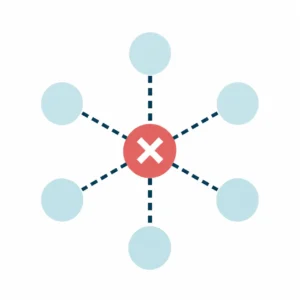
Concentrated
Single points of failure: when one hub, cable or operator fails, disruption spreads across the whole system.
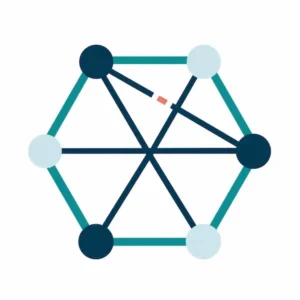
Resilient by design
Diverse, interoperable paths and autonomous recovery keep essential services running when parts of the network fail.
The approach
Resilience as a built-in property, not an afterthought
RESILIOUS unites design, detection, recovery and governance into a single framework, so that Europe’s networks remain available and controllable during disruption.
Measure
Shared resilience metrics and threat models across terrestrial, submarine and satellite domains.
Anticipate
Real-time sensing and analytics for early warning and cross-domain situational awareness.
Contain
Interoperable architectures that limit how far failures and attacks can spread.
Restore
Autonomous, energy-aware recovery that keeps essential services running in degraded mode.
Satellite networks
Submarine cables
Terrestrial & mobile networks
Internet governance
Scientific programme
Fifteen projects, four work packages
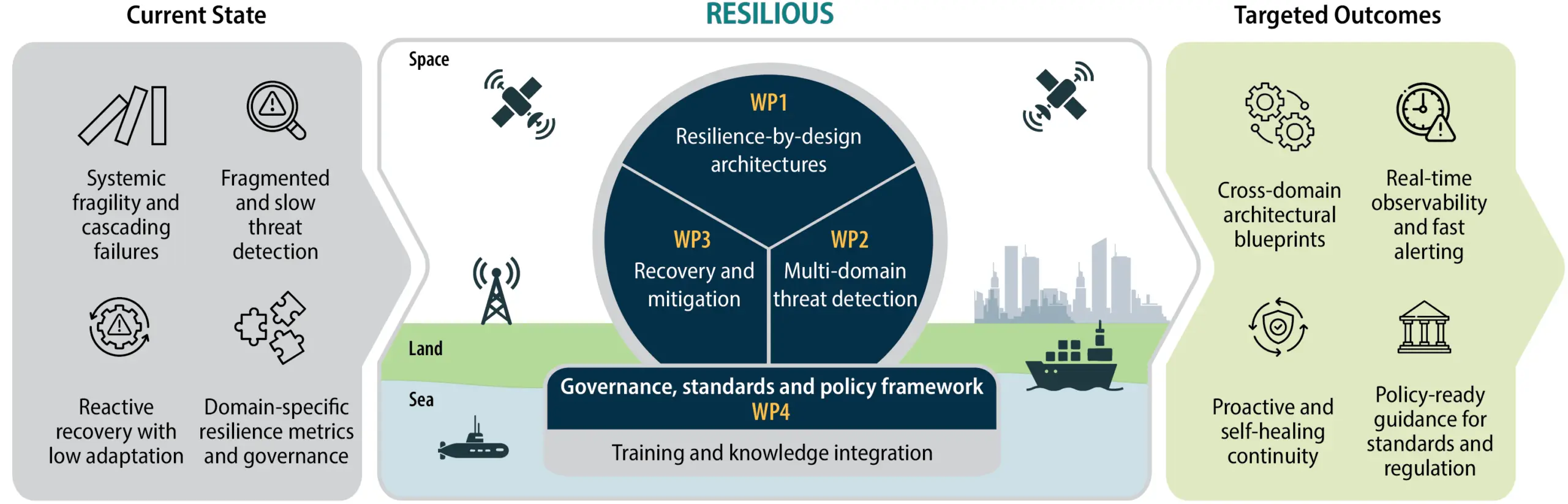
The RESILIOUS research programme consists of 15 individual doctoral projects organised in four research work packages. Shared methodologies, data models and evaluation frameworks connect the projects, supported by joint supervision and academic and industrial secondments.
WP1
Resilient architectures for sovereign communication infrastructure
WP1 embeds robustness and resilience-by-design into Europe’s satellite, terrestrial and submarine infrastructure. Research includes:
- resilient-by-design architectures for LEO mega-constellations;
- cross-operator satellite link interoperability;
- modelling the economics and resilience of Europe’s Internet interconnection;
- predictive robotic inspection of undersea cables.
WP2
Multi-domain threat detection and situational awareness
WP2 links satellite, terrestrial, aerial and maritime systems into a shared detection framework. Key research areas include:
- detecting stealth satellites and cyber anomalies in space–ground systems;
- tracking unregistered orbital proximity threats;
- sensing drone intrusions with 5G/6G networks;
- identifying maritime threats through underwater acoustic sensing.
WP3
Autonomous recovery and self-healing networks
WP3 turns detection into adaptive control that keeps services available during disruption. Expected outputs include:
- adaptive inter-satellite routing for LEO constellations;
- zero-energy retroreflectors for localisation without GNSS;
- autonomous self-healing for critical terrestrial networks;
- degraded-mode operation for underwater communication.
WP4
Governance, standards and policy for resilient connectivity
WP4 translates technical results into instruments for standardisation, regulation and procurement. Research includes:
- how competition and standard-development processes affect resilience;
- institutional bottlenecks and geopolitical fault lines in Internet governance;
- regulatory thresholds for anomaly detection in submarine and space systems;
- certification and auditing frameworks for resilience metrics.
Integrated doctoral training
The research programme is supported by network-wide training in:
- resilient LEO networking and routing;
- subsea communication and AUV planning;
- unsupervised learning and anomaly detection;
- integrated sensing and communication (ISAC) and passive RF sensing;
- Internet measurement and techno-economics;
- Internet standardisation and governance;
- intellectual property, entrepreneurship and exploitation;
- scientific communication and transferable skills.
Every doctoral candidate completes two secondments, including time with a non-academic partner, and is supported by joint academic–industrial supervision and a Personal Career Development Plan.